QR menus and allergens: what the regulation requires
Regulation (EU) No 1169/2011 requires 14 allergens to be declared. What that means for a restaurant: non-prepacked food, written or oral, and the Belgian, French and Dutch rules.
Regulation (EU) No 1169/2011 makes the declaration of 14 allergens mandatory, including for dishes served non-prepacked in a restaurant (Art. 44(1)(a)). Each Member State sets the form: in Belgium and the Netherlands the information may be given orally under strict conditions; in France it must be written.
Across the European Union, Regulation (EU) No 1169/2011 requires any ingredient or processing aid listed in its Annex II — fourteen substances in all — or derived from a substance or product listed there, to be declared whenever it was used to prepare a dish and is still present in the finished product, even in an altered form (Art. 9(1)(c)). For a restaurant the obligation applies to dishes served non-prepacked: a case the regulation treats separately and whose practical form each Member State may set for itself. This page covers that specific case, with the texts behind it.
The fourteen allergens in Annex II
Annex II lists them in the order below; the table gives the everyday wording in French, Dutch and English. What your declaration has to point to is the name of the substance as it stands in Annex II: in Belgium the Royal Decree of 17 July 2014 requires it to contain at least a clear reference to that name (Art. 3(2)).
| French | Dutch | English |
|---|---|---|
| Gluten | Gluten | Gluten |
| Crustacés | Schaaldieren | Crustaceans |
| Œufs | Eieren | Eggs |
| Poisson | Vis | Fish |
| Arachides | Pinda's | Peanuts |
| Soja | Soja | Soy |
| Lait | Melk | Milk |
| Fruits à coque | Noten | Nuts |
| Céleri | Selderij | Celery |
| Moutarde | Mosterd | Mustard |
| Sésame | Sesam | Sesame |
| Sulfites | Sulfieten | Sulphites |
| Lupin | Lupine | Lupin |
| Mollusques | Weekdieren | Molluscs |
Three details the text itself carries and most summaries drop. The first entry is not 'gluten' but cereals containing gluten: wheat (such as spelt and khorasan wheat), rye, barley, oats or their hybridised strains — spelt and khorasan are examples of wheat there, not separate entries, ever since Delegated Regulation (EU) No 78/2014 rewrote that point and dropped the word 'kamut', which is a registered trademark. Nuts are a closed list of eight — almonds, hazelnuts, walnuts, cashews, pecans, Brazil nuts, pistachios, macadamia nuts — and the peanut is not among them: it is a separate allergen, entry 5. And sulphites only have to be declared above 10 mg/kg or 10 mg/litre expressed as total SO2.
The case that applies to you: non-prepacked food
A dish served at a table is not prepacked food. The regulation handles this in Article 44: where foods are offered non-prepacked to the final consumer, packed on the sales premises at their request, or prepacked for direct sale, the allergen declaration (Art. 9(1)(c)) is mandatory, while the other particulars of Articles 9 and 10 — the full ingredient list, the nutrition declaration, the net quantity — are not, unless the Member State requires them.
Article 44(2) adds that Member States may adopt national measures on the means through which those particulars are made available and, where appropriate, their form of expression and presentation. That is where every difference between countries comes from: the substance is European, the form is national. The regulation itself carries one exception (Art. 21(1)): the declaration is not required for a substance where the name of the dish already refers to it clearly. Belgium adds that the name must be given in writing (Art. 3(3)). Either way it excuses only that one substance, not the other allergens in the dish.
In writing or spoken? What each country allows
In Belgium the Royal Decree of 17 July 2014 makes writing the rule: the declaration is entered clearly legibly on a physical or electronic medium, at the place where the food is offered for sale, freely and easily accessible before the purchase is concluded (Art. 3(1)). Oral is only a derogation, and a conditional one (Art. 4): the information must be given without delay at the guest's request, at the place where the food is offered for sale and before the purchase is concluded; an internal procedure must be drawn up and implemented within the establishment's self-checking system; that procedure must be set down in writing, on a physical or electronic medium, and easily accessible to the staff concerned and to the inspection authorities; the staff concerned must be trained on the risks of food allergies and intolerances and on that procedure; and no extra charge may be put on the guest who asks.
The same decree requires two notices, displayed conspicuously where non-prepacked food is offered, easily visible and clearly legible (Art. 5(1)): one indicating where, or through which device, the declaration is available — or inviting the guest to ask a member of staff; the other warning that the composition of the products may change from one time to the next. If you sell at several separate points in the same establishment, those notices go at each of them; for distance selling they appear on the material supporting the sale. They are not required where the declaration itself is entered in a clearly apparent place, easily consulted before the purchase, nor where the operator collects guests' dietary needs in advance and can serve them individually (Art. 5(3)).
In the Netherlands the Warenwetregeling allergeneninformatie niet-voorverpakte levensmiddelen of 7 August 2014 follows a close logic. At the point of sale it must be stated clearly visibly where the allergen information is available; at each point separately if there are several in the same building; and that information is made available on the spot, in writing or electronically, freely accessible, understandable and clearly legible (Art. 2). Oral is allowed by derogation (Art. 3) if the owner or an employee can communicate it at any time, without delay and correctly, before the purchase takes place; if it is at all times available in writing or electronically to staff and to the NVWA; and if a clearly visible notice at the point of sale asks the consumer to turn to staff.
France is stricter here. Decree No 2015-447 of 17 April 2015, which introduced Article R. 112-13 of the code de la consommation — recodified as Article R. 412-14 by Decree No 2016-884 of 29 June 2016 —, provides that in places where meals are offered to be eaten on the premises, the consumer must be given, in written form, legible and visible from the areas open to the public, either the allergen information itself or the arrangements by which it is kept available — and in that second case the consumer must be able to access that information directly and freely, available in written form. In other words: no purely oral option.
Where the obligation sits: the operator, not the server
The regulation names a responsible party: the food business operator under whose name or business name the food is marketed (Art. 8(1)). That operator must ensure the presence and accuracy of the information (Art. 8(2)) and, within the businesses under their control, ensure compliance with the rules relevant to their activities and verify that they are met (Art. 8(5)). A guest misinformed by a server is therefore not the server's problem: it is the establishment's failure.
The national texts turn that into checkable obligations. In Belgium, if you answer orally, the procedure must exist in writing and be accessible to staff and to inspectors, and the staff concerned must be trained (Art. 4, points 3 and 4). In the Netherlands the information must be permanently available in writing or electronically to staff and to the NVWA (Art. 3(b)). In both cases an oral answer is only sound if something written stands behind it.
What this means for a QR menu
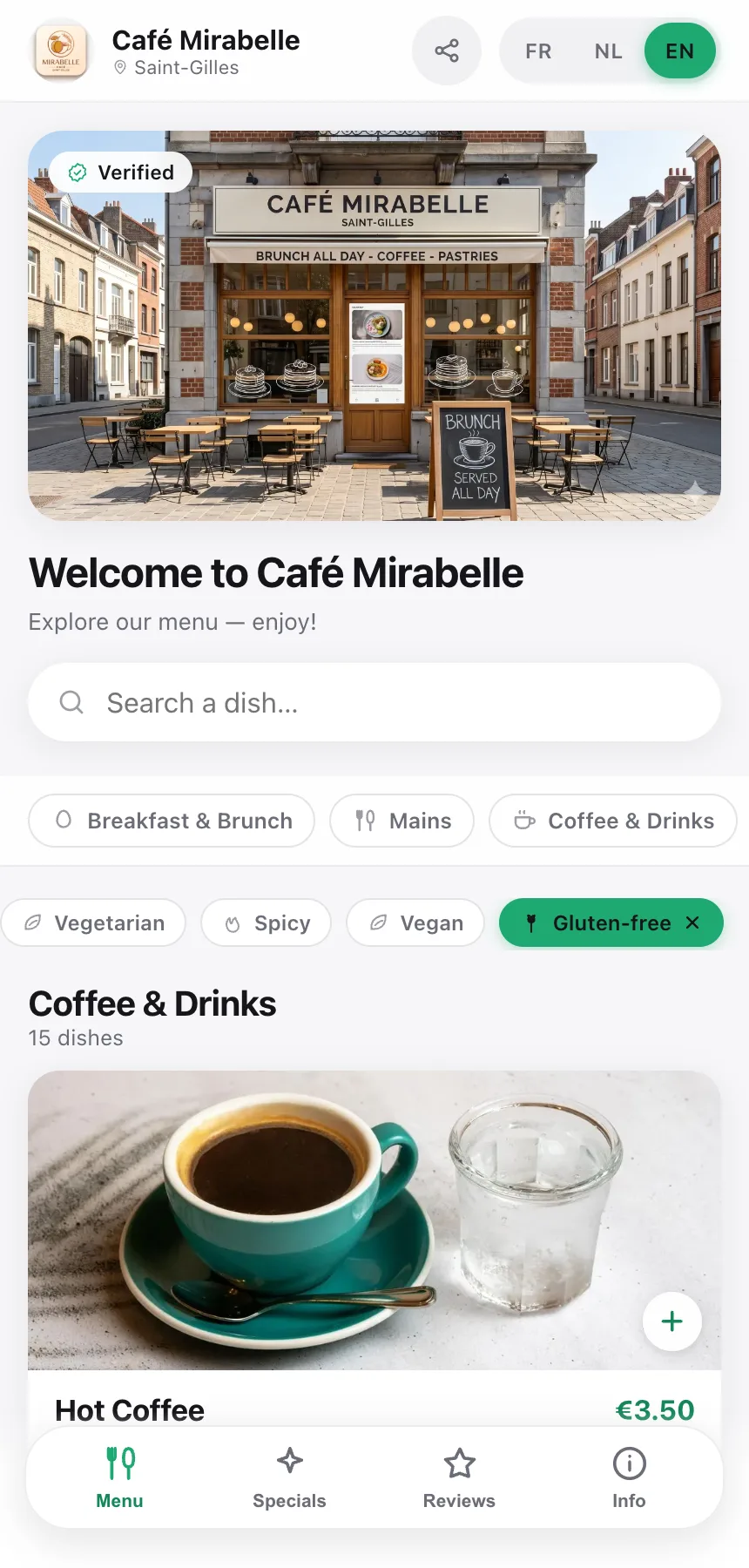
First, the declaration attaches to the dish, not to the footer. The Belgian decree asks for a clear reference to the name of the Annex II substance (Art. 3(2)); a blanket note along the lines of 'our dishes may contain allergens' does not say which dish contains what, and so informs nobody. Second, a digital medium is explicitly contemplated: Belgium speaks of a physical or electronic medium (Art. 3(1)), the Netherlands of making the information available in writing or electronically (Art. 2(3)). A menu consulted through a QR code falls in that category of medium — provided it is freely and easily accessible before ordering, which is exactly the criterion in the text.
Third, accuracy is a continuing obligation, not a state you reach once. Article 8(2) requires the accuracy of the information to be ensured, and the Belgian decree has you warn guests precisely that the composition of products may change from one time to the next (Art. 5(1), point 2). On a paper menu every recipe change means a reprint, and in the meantime the menu is wrong. With a digital menu you tick allergens per dish and the correction is online the same day — the only difference between the two media that really matters.
Finally, a point to settle with your authority rather than with a blog post: in Belgium the Article 5 notices fall away where the declaration is entered in a clearly apparent place so that it can easily be consulted before the purchase is concluded (Art. 5(3), point 1). A menu that carries the allergens dish by dish and is handed to the guest before ordering fits that case; where the declaration is only reachable by scanning a code, keeping the Article 5 notice is the prudent position. The FASFC is the body to validate your setup.
Sources
- Regulation (EU) No 1169/2011 of 25 October 2011 on the provision of food information to consumers — Articles 8, 9, 21, 44 and Annex II, in its consolidated version (EUR-Lex, CELEX 02011R1169-20180101). Annex II point 1 there is the one as amended by Delegated Regulation (EU) No 78/2014.
- Belgium — Royal Decree of 17 July 2014 laying down the rules on the declaration of certain substances or products causing allergies or intolerances for non-prepacked foodstuffs (Belgian Official Gazette of 12 August 2014, in force on 13 December 2014).
- France — Decree No 2015-447 of 17 April 2015 on consumer information about allergens and non-prepacked foodstuffs (Official Journal of 19 April 2015), Article R. 112-13 of the code de la consommation, today Article R. 412-14.
- Netherlands — Warenwetregeling allergeneninformatie niet-voorverpakte levensmiddelen of 7 August 2014, Articles 2 and 3 (in force on 13 December 2014).
This page summarises the European framework; national implementations differ. Confirm your approach with your national authority — the FASFC in Belgium — before you settle it. This text is not legal advice.